
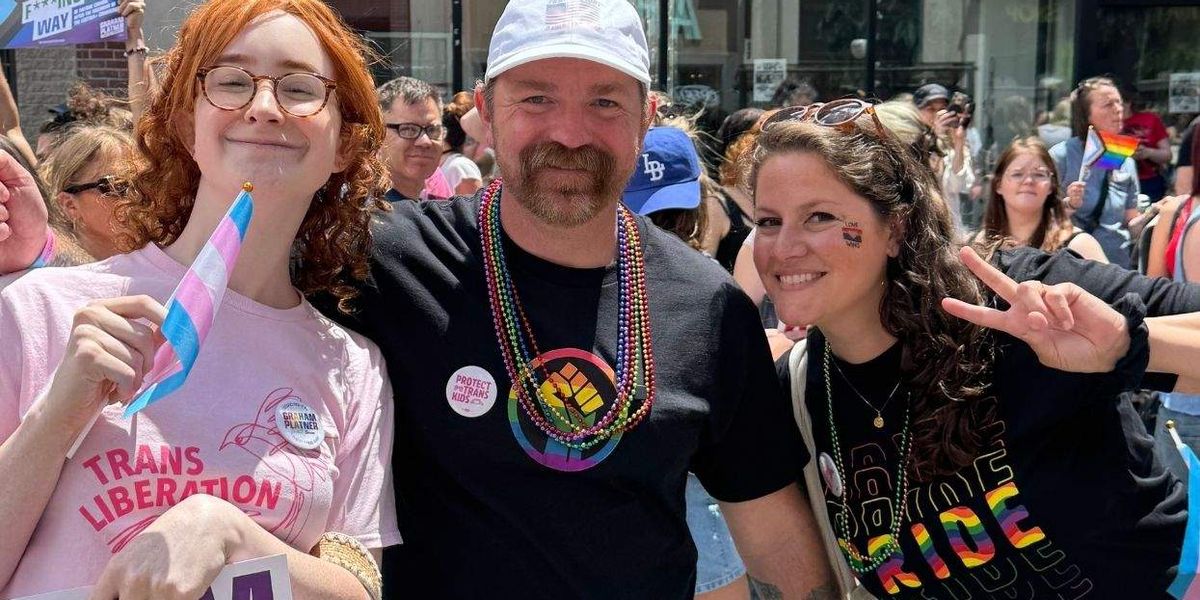
“No one, whether you’re trans or not, wants the federal government digging through your identifiable patient information and figuring out what they like and don’t like,” Hack said. “It’s an absolute overreach, and people are really scared.”

Asked whether Hack’s priorities were measures he could support, Platner agreed. “Yes, indeed. They most certainly do,” he said.

  • EldritchFemininity@lemmy.blahaj.zone
    link
    fedilink
    arrow-up
    1
    ·
    2 days ago

    And Michael Phelps has a condition that causes him to build up lactic acid at half the normal rate, effectively doubling his endurance compared to his competitors. And yet he’s allowed to hold the world record for the most gold medals won. Sports have never been about “normal” people.

    And Caster is far from the only black woman to face these kinds of punishments. In fact, not only does the Olympics have a history of racism and sexism against black women, but all three medalists were affected by the ban on Caster that year. Christine Mboma and Beatrice Basilingi were banned in 2021 for their “naturally high testosterone.” It’s a frequently occurring reason for banning black women from sports. All of them were told they could either take drugs to lower their testosterone, you know, the kind that trans women take, or undergo surgery to reduce their “naturally high testosterone” to “acceptable levels”. Understandably, none of them did. Especially not when men and white women don’t face the same kind of scrutiny. In fact, historically gender tests have often targeted female athletes of color who don’t conform to typically Western, white ideals of femininity. Serena Williams. Brittney Griner. Indian sprinter Dutee Chand. Taiwanese boxer Lin Yu-Ting. Algerian boxer Imane Khelif. The list never ends, and we haven’t even gotten to when the Olympics used to do chromosome testing in the 60s and gave up due to the extremely high number of woman athletes who came up as XY women.

    Also, the European Court of Human Rights later ruled that Caster’s ban was discrimination.

    “I was on a world scene, and what made the news was, another gymnast saying that if we painted our skin black maybe we would all win because I had beaten her out of beam medal, and she got upset,” she said on the TODAY show. “And that [was] really the news, rather than me winning worlds”

    -Simone Biles, Olympic Gymnast

    Sounds a lot like the criticism levied against trans athletes.

    • panthera_@lemmy.today
      link
      fedilink
      arrow-up
      1
      arrow-down
      1
      ·
      14 hours ago

      For the 2028 Olympics, the presence of the SRY will be used to determine gender. This refutes your claim of discrimination against

      • EldritchFemininity@lemmy.blahaj.zone
        link
        fedilink
        arrow-up
        1
        ·
        edit-2
        2 hours ago

        One of the most controversial uses of this discovery was as a means for sex verification at the Olympic Games, under a system implemented by the International Olympic Committee in 1992. Athletes with an SRY gene were not permitted to participate as females, although all athletes in whom this was “detected” at the 1996 Summer Olympics were ruled false positives and were not disqualified. Specifically, eight female participants (out of a total of 3387) at these games were found to have the SRY gene. However, after further investigation of their genetic conditions, all these athletes were verified as female and allowed to compete. These athletes were found to have either partial or full androgen insensitivity, despite having an SRY gene, making them externally phenotypically female. In the late 1990s, a number of relevant professional societies in United States called for elimination of gender verification, including the American Medical Association, stating that the method used was uncertain and ineffective.

        They already tried that 30 years ago and it proved ineffective and only led to false positives.

        Various international medical and sports professionals have, since 1986, advocated for the abolition of sex verification in sport, and specifically the Olympics. In 2000, following the 1999 IOC ratification of the 1996 decision to discontinue sex verification, the view was reiterated in the Journal of the American Medical Association; it included commentary that, while the purpose of such tests is to uphold a perceived fairness, the insufficiency of the tests can produce unfair results due to potential inaccuracies and the possibility of both false negatives and false positives. The authors also deemed the tests unfair and discriminatory towards female athletes with disorders of sex development (DSD), whom it felt should be considered as women for the purposes of sport, as “few if any plausible athletic advantages exist”. It also considered the implications for female athletes who “fail” a test (either as an error or through unknowingly having a DSD), in their personal lives and future career, as too severe to impose the tests.

        In 2022, the World Medical Association (WMA) demanded the withdrawal of hormone-based regulations, arguing that they discriminate based on gender variation of female athletes. The Association also expressed concerns with physicians treating athletes with high levels of endogenous testosterone when the condition is not pathological.

        Other criticisms are that there is no natural physiological limit imposed on male athletes, including those who have, for example, naturally high testosterone compared to their competitors, and that there are many biological factors that produce sporting advantages but “only those associated with gender are used to exclude or disqualify athletes.”

        In a joint statement published several days before the official IOC announcement on genetic testing in March 2026, over 100 human rights and other groups criticized the proposed rule change as “a blunt and discriminatory response that is not supported by science and violates international human rights law”.

        Over 100 human rights groups apparently disagree with you on this kind of testing being discriminatory. Also that it’s a violation of human rights.

        Edit: I also like how you completely ignored the fact that all these black women were told that if they wanted to compete, they could take the same kinds of drugs that trans women take everyday. It’s almost like being trans was never an issue in the first place, since black women apparently have more testosterone than trans women. It’s always been about hate, and nothing more.

        • panthera_@lemmy.today
          link
          fedilink
          arrow-up
          1
          ·
          1 hour ago

          That is the IOC’s new rule. From https://www.forbes.com/sites/kimelsesser/2026/03/26/what-makes-an-olympic-athlete-female-the-rules-just-changed-again/

          The cheek swab or blood test that the IOC will require for female athletes will determine the presence or absence of SRY. Only those without the SRY gene will be able to compete as women in Olympic events.

          The new rule doesn’t just eliminate transgender women from eligibility, but also women with certain conditions known as differences in sexual development. Some of these individuals who were identified as female at birth may still carry the SRY gene. While they may have been raised as girls and identify as female, they likely have high testosterone levels. The presence of the SRY gene means they would not be eligible to compete in the Olympic female categories under the new rules.

          You claimed that the IOC deliberately discriminated against Black women. If that were the case, the IOC would never have switched to the new test.