As posts over in Piefed are saying, it was about the state’s rights to have slavery. Very specifically, it was about the right for new states to have slavery. Till that point, the political divide was along slave states VS not slave states, a divide which partially exists to this day. As such, to maintain the balance of political power, each new territory added as a state would alternate between being a slave state and free state. However, with expansion into the west, a representation of progress and freedom, the federal government proposed a ban, not on slavery, but the enacting of new slave states. All existing Southern states would still have slavery.
Fun fact! Utah entered the union as a slave state but did not secede (because they thought seceding would invite federal attention and they had enough of that in the Mormon War). I’m not sure what makes the fact fun, but it’s on the list
Instead they tried to contribute nothing to the union cause.
Another unfun fact, Oregon wasn’t a slave state, because their black exclusion laws defined that slavery and involuntary servitude shall be forever prohibited in Oregon and than any “negro or mulatto” residing in the state for more than six months would receive 39 lashes.
It was amended a few months later due to the lashes being seen as “excessive” so that instead the punishment was to “publicly hire out” the individual for the “shortest term of service” after which they would need to be removed within 6 months.
It really set the template for the sort of “just slavery with extra steps” that became the 13th amendment and post-emancipation US.
Mormon history is so exceedingly bloody and fucked up that is actually kind of amazing how thoroughly they’ve been able to reverse that completely and convince outsiders that they’re just peaceful, pleasant people.
It was about the governmental balance of power, of course. But it was also about slaveholders wanting to expand their wealth. While chattel slavery in the antebellum south wasn’t capitalism, with the invention of the cotton gin and de facto “industrialization” of cotton production, these slaveholders were generating large surpluses that needed to be reinvested i.e. capital. Couple that with the fact that slaves literally reproduce themselves and they need to have somewhere to work in order to generate profit or at a minimum preserve themselves, southern slavers eyed the west greedily. They needed western states to be slaves states so they could purchase large tracts of land and move their slaves out there. Forcing slavery to exist only in the south would create a situation where slaveholders would not only not have outlet for capital reinvestment, but also no outlet for a growing slave population.
Exactly. The cotton gin is so often an under looked invention in American history, but it single-handedly solidified the power of slave owners and their reliance on slave labor. The promise of new lands to extract value from via plantations must have been extremely tempting to the slave owners.
Wage labor - and a class of workers who have nothing to sell but their labor - is a part of what defines capitalism. I mean, I don’t want to be so rigid as to say the economic system in the South was nothing like capitalism though, these things don’t always have firm boundaries.
Edit: I’m literally a communist, in no way should my explanation be considered “defending” capitalism. Chattel slavery and capitalism were inexorably entwined together, I’m just getting into the weeds on definitions.
Kind of an important point. It’s so weird how people are ready to accept the assumption that the government suddenly started caring about actual people just for the civil war.


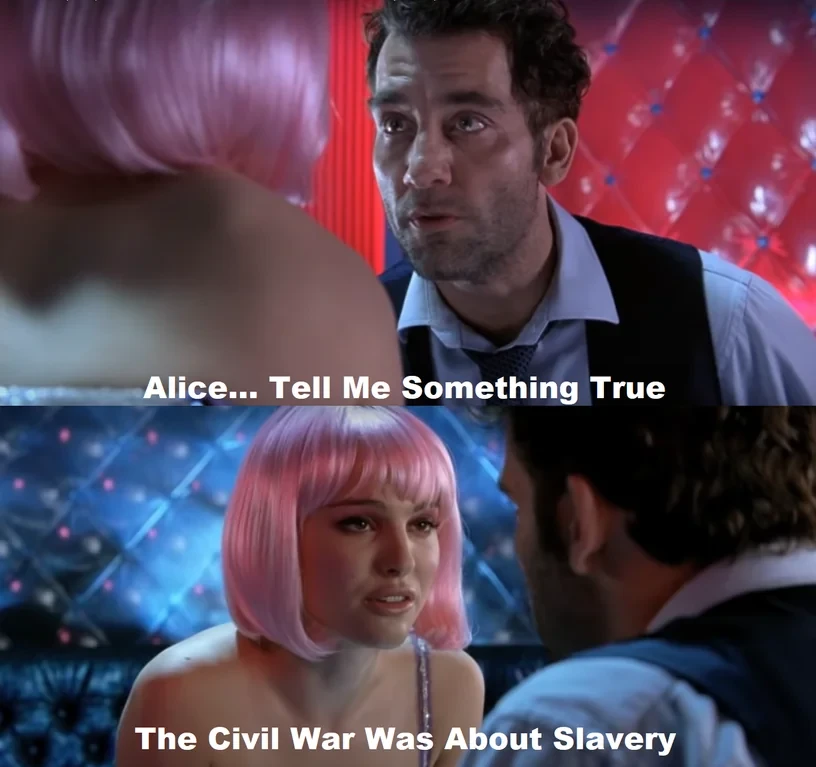
As posts over in Piefed are saying, it was about the state’s rights to have slavery. Very specifically, it was about the right for new states to have slavery. Till that point, the political divide was along slave states VS not slave states, a divide which partially exists to this day. As such, to maintain the balance of political power, each new territory added as a state would alternate between being a slave state and free state. However, with expansion into the west, a representation of progress and freedom, the federal government proposed a ban, not on slavery, but the enacting of new slave states. All existing Southern states would still have slavery.
Fun fact! Utah entered the union as a slave state but did not secede (because they thought seceding would invite federal attention and they had enough of that in the Mormon War). I’m not sure what makes the fact fun, but it’s on the list
Instead they tried to contribute nothing to the union cause.
Another unfun fact, Oregon wasn’t a slave state, because their black exclusion laws defined that slavery and involuntary servitude shall be forever prohibited in Oregon and than any “negro or mulatto” residing in the state for more than six months would receive 39 lashes.
It was amended a few months later due to the lashes being seen as “excessive” so that instead the punishment was to “publicly hire out” the individual for the “shortest term of service” after which they would need to be removed within 6 months.
It really set the template for the sort of “just slavery with extra steps” that became the 13th amendment and post-emancipation US.
Another unfun fact, that’s why Oklahoma has a panhandle. Texas wanted to enter the Union as a slave state, but it wasn’t allowed below a certain line of latitude. So Texas gave up some of its territory to ensure it could enter as a slave state, and a portion of that territory became the panhandle.
Mormon history is so exceedingly bloody and fucked up that is actually kind of amazing how thoroughly they’ve been able to reverse that completely and convince outsiders that they’re just peaceful, pleasant people.
you must be mormon if you think that they’ve convinced outsiders they’re pleasant
I think most people see them as super polite teetotalers. Most Americans are completely oblivious to the violent history.
It was about the governmental balance of power, of course. But it was also about slaveholders wanting to expand their wealth. While chattel slavery in the antebellum south wasn’t capitalism, with the invention of the cotton gin and de facto “industrialization” of cotton production, these slaveholders were generating large surpluses that needed to be reinvested i.e. capital. Couple that with the fact that slaves literally reproduce themselves and they need to have somewhere to work in order to generate profit or at a minimum preserve themselves, southern slavers eyed the west greedily. They needed western states to be slaves states so they could purchase large tracts of land and move their slaves out there. Forcing slavery to exist only in the south would create a situation where slaveholders would not only not have outlet for capital reinvestment, but also no outlet for a growing slave population.
Exactly. The cotton gin is so often an under looked invention in American history, but it single-handedly solidified the power of slave owners and their reliance on slave labor. The promise of new lands to extract value from via plantations must have been extremely tempting to the slave owners.
How was it not capitalism? They literally bought and sold people.
Wage labor - and a class of workers who have nothing to sell but their labor - is a part of what defines capitalism. I mean, I don’t want to be so rigid as to say the economic system in the South was nothing like capitalism though, these things don’t always have firm boundaries.
Edit: I’m literally a communist, in no way should my explanation be considered “defending” capitalism. Chattel slavery and capitalism were inexorably entwined together, I’m just getting into the weeds on definitions.
Kind of an important point. It’s so weird how people are ready to accept the assumption that the government suddenly started caring about actual people just for the civil war.